Patrick Stirling
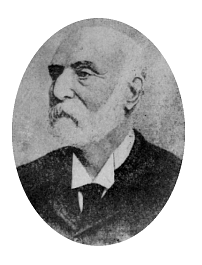
Patrick Stirling was born at Kilmarnock in 1820, the son of Reverend Robert Stirling (inventor of the Stirling Engine). Stirling served as an apprentice at the Dundee Foundry of Urquhart Lindsay & Co, and worked his way to become foreman at Neilson's Locomotive Works in Glasgow. He was then appointed in 1851 to be superintendent of a short line between Bowling and Balloch (River Clyde to Loch Lomond), which later became a part of the North British Railway (NBR). Then in 1853 he was appointed to the position of Locomotive Superintendent of the Glasgow & South Western Railway (G&SWR). After 13 years at the G&SWR, Stirling moved to the Great Northern Railway (GNR) in 1866, where he stayed until dying in office in 1895.
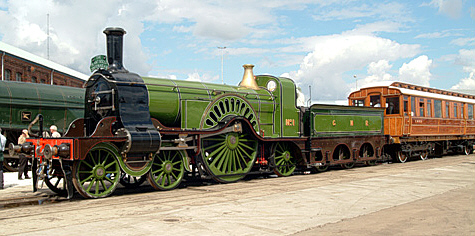
During the early years of Stirling's tenure, many new engines were required for the many new routes which were still being built. Stirling built his engines for speed and power, in order to handle some of the continuous gradients on the main York-London GNR line, and to compete against the Midland Railway and L&NWR in the "Races to the North". A product of these races were the famous "Stirling Singles". These were elegant 4-2-2 engines with eight foot driving wheels, and domeless boilers. These popular engines regularly set speed records in the races of 1888 and 1895. None of these survived into regular LNER stock, although Stirling Single No.1 is now a part of the National Collection at the National Railway Museum in York.
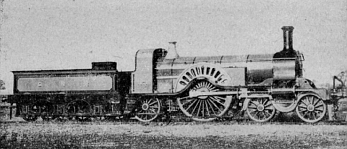
Stirling disliked the concept of compound engines, and preferred designs with outside cylinders and domeless boilers.
Stirling was well-liked by the railwaymen of the GNR. For his 70th birthday, they erected a fountain in his honour in Doncaster, and 3000 GNR railwaymen braved pouring rain to accompany his funeral procession when he died in 1895.
His son Matthew Stirling was Locomotive Superintendent for the Hull & Barnsley Railway.
Acknowledgements
Thank you to Geoff Byman FRPS for the photograph of Stirling Single No. 1 at the Doncaster 150 celebrations.