The Grimsby & Immingham Tramway
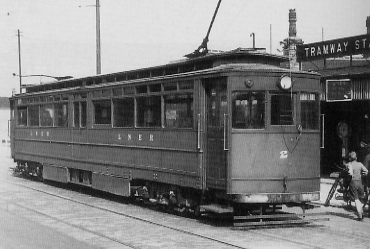
The Grimsby & Immingham Tramway was built by the Great Central Railway (GCR) to convey passengers (usually dock workers) to the GCR's new docks at Immingham. The tram replaced a GCR steam railcar service which ran on the the parallel Grimsby District Light Railway - originally laid by the dock contractor. The tram was inspected on 22nd November 1911, and initially opened for traffic on 15th May 1912 to Immingham Town. The final section to Immingham Dock's Eastern Jetty opened on 17th November 1913.
The tram was built as a conventional street tramway between Grimsby Corporation Bridge and Cleveland Bridge, and for a short stretch at Immingham. The remainder ran on reserved flat-bottomed track alongside the steam-operated goods line. The LNER later replaced this flat-bottomed rail with bull-head rail. Bull-head rail was also used on the Eastern Jetty section. The Eastern Jetty section was also the only double-tracked section of the line. The remainder was single-track with passing loops. A branch from Immingham Queens Road to the Immingham locomotive shed was inspected in 1915, but was never used regularly. The branch was disconnected in 1946 and lifted in 1955. Excluding this branch, the tram was 7.75 miles in length. Although it used standard gauge, it did not have a physical connection to the main GCR system. Cars were lifted between adjacent tracks by crane, when they had to be sent to the GCR works for overhaul.
Immingham Dock's power station provided 6600V 50Hz AC to three tramway sub-stations. These converted the power to 500V DC for the tramway's overhead line. The dock's power station closed on November 1957, after which power was supplied by the Yorkshire Electricity Board.
The Grimsby & Immingham Tramway initially opened with eight single-deck bogie trams supplied by Brush Electrical Engineering Co. Ltd of Loughborough. Nos. 1-4 were Britain's longest trams at 54ft 2in long. These were mounted on Brush Standard 4ft 6in wheelbase trucks with Dick Kerr DK9 50hp motors on the inner axles. Dick Kerr DB1 K4 controllers fitted with rheostatic and magnetic braking. The cars could take 32 passengers on reversible seats, 8 on tip-up seats, and about 30 additional standing passengers. The other four cars (Nos. 5-8) were 38ft 10in long, and were intended for a proposed line into the centre of Grimsby. These could take 48 seated passengers and were powered by smaller DK10B 35hp motors. The line was never built, and these four trams were withdrawn in 1931/3 by the LNER. One (No. 5) was converted into a works car and survived until 1954.
Eight more cars similar to Nos. 1-4 were built in two batches in 1913 and 1915. The second batch appears to have been built or completed by the GCR but were similar to the existing Brush trams. During the 1920s, all of the trams were modified to include steel body panels, underfloor toolboxes, and platform doors. The head lamps were also moved from the end of the roof to a position immediately above the windscreen. The 1915 batch of four trams are believed to have incorporated most of these features from-new. Later modifications included carbon-shoe collectors in 1940 to avoid sparks during black-outs, and heaters in 1957-8. At least four of the Brush trams received new ends after collisions in fog. Two were withdrawn in 1951 after a collision, and two more were withdrawn in 1952. The remaining eight Brush trams survived until closure in 1961.
British Railways (BR) purchased three single deck maximum-traction air-braked bogie trams from Newcastle Corporation in 1948. These were the only Grimsby & Immingham trams to have upholstered seats. These were followed in 1951 by nineteen single deck trams purchased from Gateshead & District Tramways Company. One of these replaced the No. 5 Works Car. A second tram was damaged when a crane fell on it during unloading, and never entered service. BR modified the Gateshead trams by adding a second lamp, re-profiling the wheels, and disconnecting the anti-runback feature on the controller. The Newcastle trams appear to have been a stop-gap, and were withdrawn in 1953 - shortly after the Gateshead trams entered service.
The GCR painted the trams in their reddish-brown carriage livery. The LNER used their varnished teak carriage livery. This was lined until 1938 when most cars adopted an unlined livery. Wartime shortages led to a dark unlined brown livery from 1944-6. British Railways adopted a green livery similar to that used for electric multiple units. However, the brown livery managed to survive until 1956, and at least two Gateshead trams operated in their original dark red and cream livery for a few years.
Services were usually half-hourly during the day, and hourly at night and on Sundays. After World War 2, new peak tram services were added to handle traffic resulting from the new chemical industries being built on the Humber Bank. During this period, convoys of up to six trams were often used. Demand peaked at nineteen cars in service in 1954-6.
The Grimsby section from Corporation Bridge to Cleveland Bridge was closed on 1st July 1956, and replaced by Grimsby Corporation buses. The remainder of the line switched to part-day working on 28th September 1959. The middle sub-station was also closed at about this time. The tramway finally closed on 1st July 1961, after road improvements had been completed.
Preservation
Three trams have survived into preservation from the Grimsby & Immingham line.
One of the original GCR cars (No. 14) has been preserved as a part of the National Collection.
Two of the ex-Gateshead cars survive. No. 20 is now preserved as Gateshead No. 5 at the Crich Tramway Village, and No. 26 (ex-No.10) is owned by the Beamish Open Air Museum, and usually runs as Gateshead No. 10.
A a four-wheel trailer tower wagon has been scrapped, but the wheels survive under Sheffield Tram No. 74 at Crich Tramway Village.
Models
I am not aware of any ready-to-run models of the Grimsby & Immingham trams. Resin body parts are available or are under development by East Lancs Model Tramway Supplies and can be produced to-order in 3mm, 4mm, and 7mm scales.
Worsley Works also produce body shell etches for 4mm scale.