The Jones M2 (Metropolitan Class G) 0-6-4T Locomotives
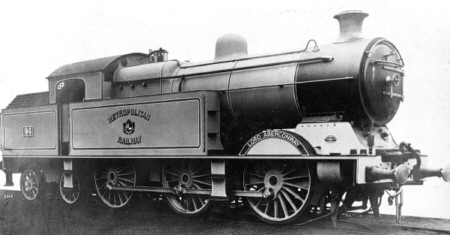
The M2s were designed by Charles Jones for the Metropolitan Railway in 1915. Designed to handle increased mixed traffic due to the War, these engines were the largest the Metropolitan had seen by this time. Only one batch of four locomotives was constructed by the Yorkshire Engine Company between 1915 and 1916.
Although officially designed by Charles Jones, they incorporated a number of Great Central Railway (GCR) features including a Robinson superheater with draught retarders; and the general design of the motion, cab, and coal bunker. The inside cylinders had piston valves that were operated by Stephenson motion. The boiler had the same main dimensions as the H2 4-4-4Ts, but over time the M2s were given superheaters with slightly smaller heating surfaces.
The Class G locomotives were taken over by the LNER on 1st November 1937, along with the other Metropolitan Railway locomotives.
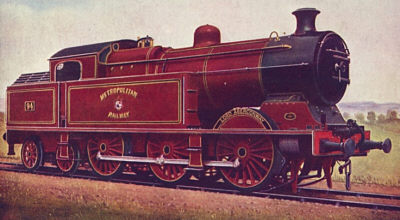
The draught retarders were gradually replaced with Maunsell snifting valves. This started during Metropolitan ownership, although the last (No. 6154) was not converted until 1939. At the outbreak of World War 2, they were amended to fit within the LNER Composite Loading Gauge. It turned out that this was unnecessary as they would never operate away from their original Metropolitan routes.
The M2s were designed for mixed traffic duties, but after the H2 4-4-4Ts were introduced, they rarely hauled passenger services. The Metropolitan classed the M2s as having the same hauling ability as the L2 2-6-4Ts, but operationally the L2s were always preferred. Both the LNER and British Railways (BR) classed the M2s as less powerful than the L2s. During World War 2, locomotive shortages led to the M2s being used on some passenger services north of Rickmansworth.
During LNER ownership, the four M2s were considered non-standard. This was especially the case when Thompson's standardisation programme came into effect. The first M2 was withdrawn in 1943, and the last two just survived into BR ownership and were withdrawn in 1948.
Technical Details
| Cylinders (x2): | (inside) | 20x26in. |
| Motion: | Stephenson | 8in. piston valves |
| Boiler: | Max. Diameter: | 5ft |
| Pressure: | 160psi | |
| Diagram No.: | 12A | |
| Heating Surface: | Total: | 1354 sq.ft. |
| Firebox: | 132 sq.ft. | |
| Superheater: | 197 sq.ft. (18x1.2in | |
| Tubes: | 281 sq.ft. (143x 1.75in) | |
| Flues: | 281 sq.ft. (18x 5.25in) | |
| Grate Area: | 21.4 sq.ft. | |
| Wheels: | Coupled: | 5ft 9in |
| Trailing: | 3ft 6in | |
| Tractive Effort: | (@ 85% boiler pressure) | 20,498lb |
| Total Wheelbase: | 28ft 9in | |
| Engine Weight: | (full) | 71 tons 1cwt |
| Max. Axle Load: | 18 tons 13cwt | |
| Coal Capacity: | 4 tons 10cwt | |
| Water Capacity: | 2000 gallons |
Preservation
The last two M2s were withdrawn in 1948, and none survived into preservation.
Models
I am not aware of any models of the M2 locomotives in any scale.
Locomotives
| LPTB No. | 1937 LNER No. | 1946 No. | BR No. | Build Date | Disposal Date | Name |
| 94 | 6154 | (9075) | - | 12/1915 | 5/1946 | Lord Aberconway |
| 95 | 6155 | 9076 | (69076) | 1/1916 | 10/1948 | Robert H. Selbie |
| 96 | 6156 | 9077 | (69077) | 2/1916 | 10/1948 | Charles Jones |
| 97 | 6157 | - | - | 3/1916 | 1/1943 | Brill |
Notes:
LPTB is the London Passenger Transport Board, which the Metropolitan Railway became a part of.
Locomotive numbers in brackets were allocated, but withdrawal occurred before the number was applied.
The first two locomotives were named after managers of the Metropolitan Railway. Jones was the CME, and Brill
was the furthest station from London that was served by the Metropolitan.
Acknowledgements
Thank you to Mike Morant Collection for the above colour illustration of the M2 Lord Aberconway.
Thank you Malcolm Peirson for the works photograph of Metropolitan Railway No. 94 Lord Aberconway.