Locomotive History of the GNSR
The GNSR's locomotive fleet is noted for being dominated by 4-4-0s and not containing a single goods locomotive. This was only true in the GNSR's later years, and things were different when it first opened to traffic.
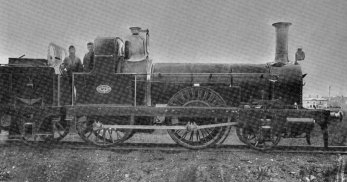
The first twelve locomotives ordered for the new GNSR were designed by Mr. D.K. Clark and built by Messrs. W. Fairbairn of Manchester. Seven were passenger 2-4-0s. Five were goods 2-4-0s, but these were originally designed as 0-6-0s. Deliveries were late, and the first goods engines did not arrive until June 1855. These, and many later GNSR locomotives, were fitted with Mr. Clark's patent smoke preventing system. This had a series of holes in the sides of the firebox above the fuel, that allowed jets of steam to be projected. The steam circulated air in the firebox. The better combustion is also reported to have resulted in improved fuel economy. All twelve locomotives were withdrawn between 1879 and 1898. The original passenger locomotives were heavily worked in their early years and tended to be the first to be withdrawn.
Mr. Clark resigned in 1855 and was succeeded as Locomotive Superintendent by M.J.F.Ruthven. The Aberdeen Harbour branch was opened in 1856, and banking locomotives were urgently required. Two 0-4-0 well tanks (Nos. 13 & 14) were purchased from Beyer, Peacock. These two locomotives would become the longest lasting of any GNSR locomotives. They were re-boilered by Manson in 1887, but retained their brass domes and copper-capped chimneys. The GNSR later moved them to shunting duties at Keith, Elgin, and Daluaine Distillery, before selling them to the War Department in 1916. After a number of different owners, No. 14A was reported to be still in use in 1934 at Tareni Colliery Co. Ltd. in Glamorganshire.
Cowan became Locomotive Superintendent in 1857, and purchased the last of the GNSR's 2-4-0s (Nos. 19-27) between 1859 and 1861. Built by Stephensons & Co, these were similar to the existing goods locomotives but they were fitted with a shorter wheelbase. Wheels were 5ft 1in diameter, and operated by 16 x 22in cylinders. Although these locomotives were the last of the 2-4-0s, they started the GNSR tradition of building locomotives in tiny batches of 2 or 3 locomotives.
In 1862, Cowan switched from the 2-4-0 wheel arrangement to the 4-4-0 arrangement for which the GNSR would become known. These were the first outside cylinder 4-4-0s in Britain, and almost Britain's first 4-4-0s of any cylinder arrangement. The 5ft 1in driving wheel diameter, and 16 x 22in cylinders were retained. Nine of these locomotives were built in 1862 and 1864. All future GNSR tender locomotives would be 4-4-0s - many of which survived into LNER ownership. Over time, these would become larger and more powerful, and take on a modern appearance with Ramsbottom valves and painted domes. All were passenger locomotives, or technically mixed-traffic locomotives. The GNSR never operated any goods 4-4-0 locomotives, instead preferring the flexibility of mixed traffic locomotives.
Of note are Manson's two Class N (LNER D46) locomotives. These were built at the limited workshop facilities at Kittybrewster in 1887. The workshops only had space for four locomotives, so much of the construction occurred outside. The Chairman reported savings of £300-400, but construction of further locomotives was not considered practical until the new works at Inverurie were operational.
Manson's tenure with the GNSR produced some very useful locomotives, but his greatest achievement is considered to be his automatic tablet exchanger. Even with the modernisation and double tracking during the 1880s, most of the GNSR was single-tracked. Manual tablets were being adopted for single track operation, but this required excessive slowing by the train and often resulted in injuries. Manson initially tried a system similar to that used for mail bags, but this did not work satisfactorily. The final system was inspired by an apparatus for transferring cotton in use at Broadford Works. This had been observed by Kittybrewster blacksmith, Mr. John Duncan, who had previously been employed at Broadford. The apparatus consisted of a post with two forks, and the ground. One fork faces the towards the approaching train, the other faces in the opposite direction. A similar post and pair of forks are located on the locomotive, and positioned so that these forks pass just over the ground-mounted forks. The tablets are placed in a strong flat leather pouch. The one to be picked up is placed in the forward facing ground-mounted fork. This is picked up by the forward facing fork on the locomotive. Similarly, the tablet to be dropped is placed the backwards-facing locomotive-mounted fork, and is picked up by the backward facing fork on the ground. Both sets of apparatus could be stowed by levers when not in operation. The height of the locomotive apparatus was calibrated with a gauge that was fitted to the Kittybrewster turntable. The apparatus was given a public demonstration in May 1889. Initial tests were at low speeds, but with confidence full speed exchanges were adopted. The system was also adopted by the Highland Railway. Manson refused to patent the exchanger because he did not want to hinder the adoption of this life-saving machine.
James Johnson became Locomotive Superintendent in 1890. Johnson's tenure is noted for two very useful locomotive types. The first were the Class S (LNER D41) 4-4-0s. These represented a distinct advance on other GNSR locomotives of the day. The driving wheels were slightly larger at 6ft 1in, and the boilers operated at 165psi. The second were the Class R (LNER G10) 0-4-4Ts. These had a very similar boiler to the Class S locomotives. They were used on some of the branch line services, but were extensively used on the Aberdeen suburban services where they built a reputation for keeping to the scheduled tight timings. With Johnson's Midland Railway connections, both types had a strong Midland flavour to them. Chimneys and safety valve fittings both followed Midland practice, although the distinctive Midland spring balances were absent.
The GNSR's locomotive fleet reached its maximum size at the turn of the century, with the delivery of the first five Class V (LNER D40) locomotives from Neilsons. These continued the existing design dimensions, but were fitted with better cabs and generally smoother, more elegant lines. Eight further Class V locomotives were built at Inverurie between 1909 and 1915. Built in 1909, Nos. 27 & 29 were the first locomotives to be built at the new Inverurie Works.
The only other locomotives acquired during World War 1, were the four Manning Wardle 0-4-2T locomotives purchased to handle the heavy wartime traffic at Aberdeen Harbour. Classed as Z4 and Z5 by the LNER, all four locomotives survived into Nationalisation (1948).
Post-war, the only acquisitions were a series of eight superheated Class V locomotives - Class VS (later Class F). The LNER combined these with the saturated Class V locomotives as Class D40.