The Robinson Class S1 0-8-4 Tank Locomotives
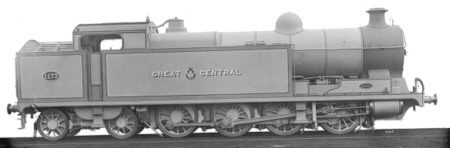
Robinson designed these powerful 0-8-4 tank locomotives in 1907 for hump shunting the newly opened Wath-on-Dearne marshalling yard in South Yorkshire. Initially, four were built between 1907 and 1908. Robinson based the S1 on his 8-coupled tender engines (LNER Q4), but had three cylinders for smooth powerful uphill shunting. Due to the extra cylinder, a slightly wider boiler was fitted. Power reversing gear was also fitted due to the constant reversing experienced in a busy marshalling yard.
These engines were generally successful, although sometimes two were needed together to shunt the heaviest trains in wet weather. Hence in 1930, Gresley tried fitting a booster to the trailing bogie. Boosters apply extra power at very slow speeds, and are usually used for starting heavy loads. Due to these being shunters, the S1 boosters were unusual because they were reversible (ie. applied power in both directions). Due to the required replacement of the complete bogie, it was considered economical to build new engines for the boosters. Hence, one locomotive (No. 6171) had a booster fitted, and two new locomotives were built with boosters in 1932. The unmodified engines were designated S1/1, whilst No. 6171 (modified) became S1/2, and the two new engines became S1/3.
It appears that the boosters had problems running in reverse. The boosters were rarely used in the reverse direction, and after one month of operation No. 6171's booster was amended so that reverse was disabled. The S1/3 engines had their reversing latches removed from the boosters, so that it was impossible to engage the boosters in the reverse direction.
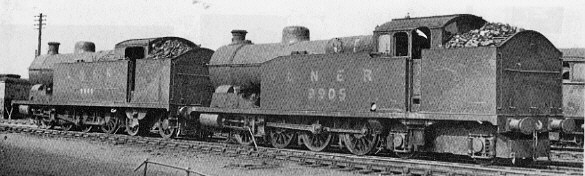
Superheaters were fitted to the S1/2 and S1/3 types, to provide the extra power for the boosters. Eventually the original S1/1s were also fitted with superheated boilers due to a lack of replacement saturated boilers of the correct size.
The boosters were removed from all three engines in 1943, although the outside frame bogies were kept.
The Wath Yard had two humps. Each hump was worked by a pair of the original S1s. The two S1/3s started work at Wath Yard, displacing two of the original S1s. These moved to the newly opened Whitemoor Yard (March, Cambridgeshire), where they stayed until being replaced by DES1 0-6-0 diesel shunters in 1949. These two engines then moved to Frodingham to haul steel from the steelworks to the yards. This was not a great success, and they moved to Wath in 1950 to join the other members of the class.
From 1950, all six S1s were at Wath, although there had never been enough work to employ this many hump shunters. In 1953, BR tested the standard BR 350hp diesel-electric shunters as hump shunters at Wath. This was a success, and the S1s were quickly replaced. Five went to Doncaster, and one locomotive was tried at Immingham Docks. Diesel shunters had tended to slip at the docks, but the S1 also had problems. Hence, it was moved to Doncaster after only 4 months at Immingham. By the end of 1953, all six S1s were at Doncaster. Most of their time at Doncaster was spent in storage, although they were occasionally used for for hauling lines of dead locomotives or other shunting duties. All six engines were eventually scrapped between 1956 and 1957.
Technical Details
The following details are for the S1/3 locomotives with the superheated boiler (Diagram No. 105), and the booster removed.
| Cylinders (x3): | 18x26in. | |
| Boiler: | Diameter: | 5ft |
| Length: | 15ft | |
| Pressure: | 180 lb/sq.in | |
| Heating Surface: | Total: | 1742 sq.ft. |
| Firebox: | 151 sq.ft. | |
| Tubes: | 885 sq.ft. | |
| Tubes: | 464 sq.ft. | |
| Superheater: | 242 sq.ft. | |
| Grate Area: | 26.24 sq.ft. | |
| Wheels: | Coupled: | 4ft 8in |
| Trailing: | 3ft 2in | |
| Total Wheelbase: | 31ft 2in | |
| Tractive Effort: | Engine (85%): | 34,523 lb |
| Booster (72.5%): | 12,373 lb | |
| Length: | 45ft 2.25in | |
| Weight: | (full) | 103t 12cwt |
| Max. Axle Load: | 19t 14cwt | |
| Water Capacity: | 2680 gallons | |
| Coal Capacity: | 6t |
Preservation
The last S1 locomotives were withdrawn in 1957, with none surviving into preservation.
Models
Gladiator Model Kits sold a 7mm scale (O gauge) brass kit of the S1. Current availability is unknown.
Acknowledgements
Thank you to the Malcolm Peirson for the works photograph of GCR No. 1173.