Locomotive History of the MGN
The locomotives in the beginning formed the quaintest assortment that ever adorned a railway of this length. This collection had been gathered together through the united efforts of the directors and officials of the Lynn and Fakenham and the Yarmouth and North Norfolk Railways. It has been commented that the overall effect was that of them being "purchased at a jumble sale". Exception must be made of four fast passenger engines which started work on the Lynn and Fakenham Railway about 12 months before the amalgamated lines became the Eastern and Midlands Railway.
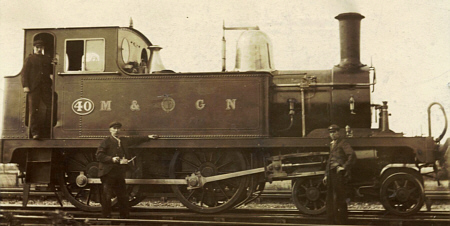
The passenger locomotive stock consisted of seven small 4-4-0 side-tank engines built by Hudswell, Clarke & Co., of Leeds, between 1878 and 1881. In spite of their small size they were well-built, excellent little engines. They worked passenger trains between Lynn and Fakenham, sometimes running two double trips per day between Yarmouth and North Walsham. Towards the end of the century, when the railway was the joint property of the Midland and Great Northern, these little engines worked branch passenger trains at Lynn, on the Bourne and Spalding section, where Nos. 19 and 20 were generally to be seen, and the Mundesley-on-Sea branch, which for a long time was worked by No.9. The other four engines of this class bore Eastern and Midlands Nos. 8, 10, 40 and 41.
The pictured example (No. 40) was loaned to the Midland Railway from 1906 to 1912, and was probably sold for scrap in 1917. The photograph of No. 40 was taken at Stalham in 1904, after it had been rebuilt with an M&GN boiler and Midland-style safety valves.
Two examples (Nos. 9 & 20) survived into the 1930s, but they were withdrawn before the entire locomotive stock came under LNER control. No. 20 is noted as being William Marriott's preferred locomotive for hauling inspectors' trains.
There were five 0-6-0 saddle-tank engines which for a time had the honour of conducting most of the goods traffic. Finally, there were eight 0-6-0 side-tank engines which had been built in 1873-74 by Sharp, Stewart and Co. for the Cornwall Minerals Railway, and came into the market at the psychological moment when locomotives were wanted for the lines in Norfolk.
With the addition of two diminutive four-wheeled contractors' engines, the above 22 engines formed the complete stock until early in 1882, and it may be noted that there was no engine on the line with driving wheels larger than 4 ft. 7.5 in. For main-line passenger traffic such engines were too small, and at the end of 1881 there appeared the first four of a series of handsome 4-4-0 engines which were built by Beyer, Peacock and Co. The first four (Nos. 21 to 24) were delivered to the Lynn and Fakenham Railway and the later engines, Nos. 25 to 35, built from 1883 to 1888, to the Eastern and Midlands. There were also two 2-4-0 passenger engines, Nos. 42 and 43, of the Allan "Crewe" type which were purchased in 1883 from the London & North Western Railway.
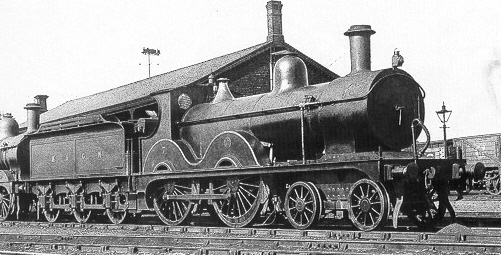
The bulk of the passenger trains between Lynn and Norwich, and between Melton Constable and Yarmouth were, of course, worked by the 4-4-0 engines 21 to 35 (Class A Rebuild and Class C). These engines also worked the former Cromer express for a short period between Lynn and Peterborough.
When further passenger engines were required in 1890-91, Mr. Marriott, M.Inst.C.E., who then had charge of the locomotive and engineering departments, decided upon the metamorphosis of some of the 0-6-0 tank engines which had come from the Cornwall Minerals Railway. It was certainly a unique reconstruction to convert these engines into 2-4-0 passenger engines. The reason which induced Mr. Marriott to convert these engines was that the small 3ft. 6in. wheels of the original engines were quite unsuitable for main-line work, which consisted principally of fast and highly competitive cattle and fish traffic.
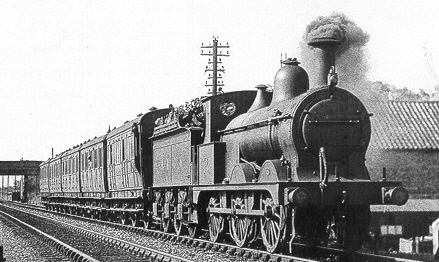
Because of the relatively early closure date, most workings throughout the life of the M&GN were operated by steam power. The M&GN mainly used designs from the MR and GNR, but included in its stock some of the older E&M engines, often much rebuilt. The famous Beyer-Peacock engines survived in this way from the early 1880s to the mid-1930s. The best contemporary designs were acquired by the Joint in the 1893 to 1901 period, but as there were no more modern engines forthcoming, the light 0-6-0s provided much of the motive power on the line until 1936. From then on the LNER tried various designs on the line, not necessarily bigger or even more recent than the Joint's own engines, but as the M&GN's engines were scrapped, newer engines such as the K2 2-6-0s became common. The ex-GER "Claud Hamilton" 4-4-0s provided the locomotive backbone of this later period.
Further Information
Photographs of many early M&GN locomotive classes can be found at here.
Acknowledgements
Thank you to Malcolm Peirson for most of the above information.
Thank you to Marcus Thompson for the above photograph of Hudswell Clarke 4-4-0T No. 40. The fireman on this photograph is Mr Albert Spruce, great-grandfather of Marcus Thompson's wife.