Locomotive History of the GER
The GER's constituent companies chose to use locomotives supplied by other companies - as was common with the smaller companies during the 19th century.
The ECR opted for Bury-type four wheelers in its early years, the N&ER for six wheelers. In 1850, ECR Locomotive Superintendent JV Gooch decided to start building locomotives at Stratford. Later on, TW Worsdell decided to build all new locomotives at Stratford. Following Worsdell's departure to the North Eastern Railway, James Holden took the office of, he was to hold this post longer than any other GER Loco Superintendent and was probably the most influential designer that the GER ever employed. He came from Quaker stock, like his predecessor, and was noted for his economical designs and his provision of large cabs for the benefit of the enginemen. He made major improvements to the layout of Stratford Works and introduced standardisation of locomotive parts and he made significant improvements to earlier designs. His locomotives tended to be simple, rugged low-maintenance engines. His "signature" features were the rimless, tapered chimney (so-called stovepipe) and the dome positioned well forward on the boiler.
He was quite innovative, introducing oil-burning, which utilised a by-product of the company gas works. The local authorities were unhappy with the gas works residues which were being run into a water course, poisoning everything downstream, Holden experimented with the residues and found them very suitable for combustion, so a burner was devised which was easily fitted and removable from the firebox. In operation, steam was raised by conventional means i.e. coal, then the fire was covered by a layer of broken firebrick, atomised oil was then sprayed into the firebox and some wood added, to provide a flame, thereafter the oil provided all the heat. The oil tank in the tender was warmed by the exhaust from the Westinghouse pump. Sixty locomotives, of a number of different classes, were converted. A notable successful trip was made by one oil-burner taking an excursion train from St Pancras to Scarborough and back in one day on a single tank of fuel.
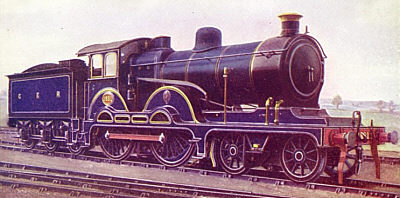
In 1900, after previously designing single-driver express engines, he designed a 4-4-0 class S46 (LNER designation D14), the first of which, numbered 1900, was named "Claud Hamilton" after Lord Claud Hamilton, the Chairman of the GER; these engines and the following developments were known as the "Clauds" and were his most successful design. Number 1900 was shown at the 1900 Paris Exhibition and attracted very favourable attention. Some features were a copper-capped chimney, brass beading and a bright steel ring around the smokebox door, in place of the usual straps. Further "Clauds" were numbered backward from 1900. From 1904, Belpaire boilers were introduced; a total of 121 "Clauds" were built altogether, the last batch was finished in 1923, under the auspices of the LNER. Some of the other features introduced by Holden, initially on the "Clauds" were compressed air powered water scoops and reversing gear. Gresley was later to make further developments, reverting to a round-topped boiler of large diameter and introducing long travel valves.
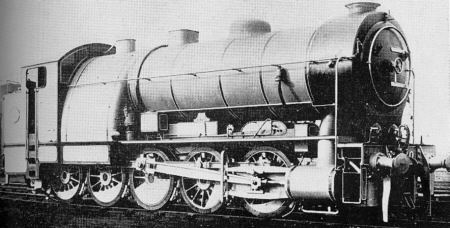
Holden's piece-de-resistance was the 'Decapod' tank, a three cylinder 0-10-0 with a 200 psi boiler. This was designed to the order of the management to provide an engine which could accelerate a 300 ton train to 30 mph in 30 seconds. This it achieved in tests (with 335 tons) and because of this success, the company were able to stop proposed new London suburban electrified lines being built, which would have been very detrimental to the company finances. Having achieved the objective and because the locomotive was really too heavy, it was quietly retired and later rebuilt into a rather strange looking 0-8-0 goods tender engine in which form it only lasted a few years before being scrapped.
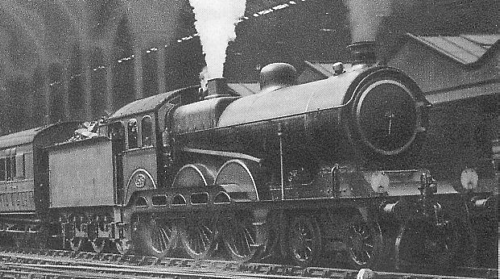
When James Holden retired he was succeeded by his son, Stephen Dewar Holden. It is generally acknowledged that SD Holden was less capable than his father, and only held office for five years. However, under his tenure the most successful GER express locomotive was designed. This was the class S69 4-6-0, known as class B12 by the LNER. It is thought that he had little input to the design, the work being done by the capable Stratford design team of which FV Russell was a notable member. In effect, the B12s were a stretched "Claud".
The final batch of B12s were built by Beyer Peacock in 1928 bringing the total to 80. Gresley experimented with them bringing about some significant improvements especially with the introduction of long travel valves. Another change to the B12s was the fitting of ACFI feed water heaters to 55 of the class. Much of the development work on the B12s was done whilst Edward Thompson was in charge at Stratford during the early 1930s. Another notable change was the fitting of round-topped boilers with a grate increased to 31 sq. ft. The B12s had exceptionally low axle loadings and because of this during LNER days, some were sent to work on the former Great North of Scotland lines and during the Second World War some members of the class were used on hospital trains and travelled the length and breadth of Britain.
SD Holden was followed by AJ Hill who was a very capable engineer. One of his designs utilised the S69/B12 boiler on an 0-6-0 chassis which became class D81 (LNER class J20) and at that time was the most powerful class of locomotives of that wheel arrangement in Britain. The design that AJ Hill is probably best remembered for is his 0-6-2 tank locomotive class L77 (LNER class N7), intended mainly for the London suburban services. This design was extremely successful and Gresley continued their production after the Grouping, some being constructed at Gorton and some at Doncaster. The Gresley locomotives had round-topped fireboxes and later developments included the fitting of long travel valves.
Acknowledgements
Thank you to Richard Barron for the above information.
Thank you to Mike Morant for the colour illustration of 'Claud Hamilton' No. 1831.
Thank you to Malcolm Peirson for the photograph of B12 No. 1505.