The Pollitt Class D5 (GCR Class 11) 4-4-0 Locomotives
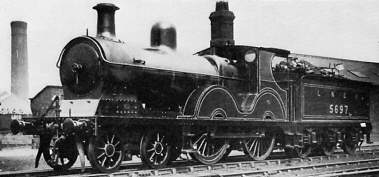
The D5s were based on Parker's last design as locomotive superintendent of the Manchester Sheffield & Lincolnshire Railway (MS&LR). Although he left in 1893, the first D5 was not built until July 1895. Pollitt modified the design a little bit during this interval. The final design was slightly longer and the boiler was pitched slightly higher. The wheelbase was increased by 3in. Timmis coiled springs replaced the original leaf springs on the rear coupled axle. The D5s were the first MS&LR passenger locomotives to have a Belpaire firebox. This design feature was introduced on domestic British locomotives four years earlier with the MS&LR's N5 0-6-2T. The inside cylinders were horizontal, but the slide valves were inclined at 1 in 10 to allow them to be driven directly by Stephenson valve motion.
A total of six locomotives were built in the second half of 1895. In 1897 Pollitt amended the D5 design to include piston valves to create the D6 design. With the introduction of the superior D6, no more D5s would be built.
The Great Central Railway (GCR) and LNER made few modifications to the D5s. Robinson fitted GCR Standard Type 3 boilers, as fitted to the saturated C13 4-4-2Ts, C14 4-4-2Ts, and D6 4-4-0s. The No. 3 boiler represented a reduction in the number of tubes from 231 to 190, and an increase in the water spaces at the sides of the firebox. They were fitted with twin-column Ramsbottom safety valves in cast-iron casings directly on top of the firebox. After Grouping (1923), the LNER fitted superheated boilers to No. 5694 (Nov. 1925) and No. 5695 (Aug. 1926). These were of the same type as the superheated boilers fitted to the D6s. The superheated engines are recorded as being 16cwt heavier than the saturated engines. From December 1927, the superheated engines were given the sub-classification of D5/2 while the original saturated engines became D5/1.
There were also a few minor modifications. With the opening of the London Extension in 1899, the D5s had their original 3080 gallon tenders replaced with 4000 gallon tenders of the type fitted to the D6s. The D5s were rarely used on the new line, and many of the original 3080 gallon tenders were refitted. Between 1924 and 1926, the LNER fitted the D5s with 4000 gallon tenders that had been built for the J10 0-6-0s.
Robinson-pattern chimneys were fitted shortly after 1900. In 1912, the cab roofs were extended backwards to cover the whole of the footplate. Cast brass number plates were fitted to the cab sides at about the same time. Between 1911 and about 1920, the entire class received extended smokeboxes similar to those fitted to the superheated D6s.
When built, the six D5s were allocated to Gorton to haul the Gorton-Grantham section of the Manchester to King's Cross through expresses. The arrival of the D6s quickly displaced the D5s from the main MS&LR passenger services. The D6s also monopolised the new London Extension when it opened in 1899, confining the D5s to the original Manchester-Sheffield-Lincoln route. By 1910, all six D5s were allocated to Neepsend shed in Sheffield, and worked between Grimsby and Leicester.
The D5s were seen further afield during the First World War, including London Extension services. Usually they were piloting GCR Atlantics (C5s and C6s), but occasionally they were seen with their own 12 coach trains.
In 1921, all six D5s were transferred to the Cheshire Lines. Initially allocated to Trafford Park, they were slowly moved to Liverpool Walton shed to replace the withdrawn D8 4-4-0 and E2 2-4-0 locomotives. Whilst working in the Cheshire area, the D5s tended to work on slower stopping services, rather than the faster Liverpool expresses. Many of these stopping services required tender-first running which was better suited to tank engines. Hence they were a natural choice for withdrawal, and withdrawals started in July 1930. No. 5699 was the last D5 to be withdrawn in March 1933. It had a life of less than 40 years.
Technical Details
The D5s were fitted with 3080 and 4000 gallon tenders. The following figures are for the 3080 gallon tender locomotives. The 4000 gallon tender locomotives had 4ft 3in tender wheels, and a full weight of 91 tons 11cwt.
| Cylinders (x2): | (inside) | 18.5x26in. |
| Motion: | Stephenson | slide-valves |
| Boiler: | Max. Diameter: | 4ft 4in |
| Pressure: | 160psi | |
| Diagram No.: | 22 | |
| Heating Surface: | Total: | 1101 sq.ft. |
| Firebox: | 108 sq.ft. | |
| Tubes: | 993 sq.ft. (190x 1.75in) | |
| Grate Area: | 19.59 sq.ft. | |
| Wheels: | Leading: | 3ft 6in |
| Coupled: | 7ft | |
| Tender: | 3ft 9in | |
| Tractive Effort: | 14,421lb | (@ 85% boiler pressure) |
| Wheelbase: | Total: | 44ft 8in |
| Engine: | 22ft 2in | |
| Tender: | 13ft 0in | |
| Weight (full): | Total: | 85 tons 17cwt |
| Engine: | 48 tons 11cwt | |
| Tender: | 37 tons 6cwt | |
| Max. Axle Load: | 17 tons |
Preservation
The last D5 was withdrawn in 1933, and none survived into preservation.
Models
I am not aware of any models of the D5s in any scale.