The Gresley D49 4-4-0 Hunt/Shire Class
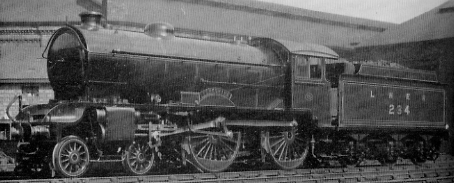
Immediately after Grouping in 1923, Gresley's initial passenger locomotive priority was that of building up the A1 Pacific numbers for use on the fastest and heaviest express services. The immediate demand for these engines was met by 1925, and Gresley started to design a new locomotive for intermediate express duties. The new locomotive had to replace aging North Eastern Railway (NER) and North British Railway (NBR) locomotives, and to supplement the use of existing NER and NBR Atlantics on the various routes that the A1s were restricted from. Hence it had to be powerful for its size, and Gresley chose to use a three cylinder arrangement using his patented conjugated valve gear. Due to a need for economy, a 4-4-0 ('American') wheel arrangement was chosen over a possibly more logical 4-4-2 ('Atlantic') wheel arrangement. Economic considerations also led to the use of the same boiler design as that used on the successful J39 0-6-0 goods engine. The design was completed in February 1926, and the first engine No. 234 Yorkshire was completed at Darlington in October 1927. The D49 would be the last LNER 4-4-0 design to be built.
A total of 76 D49s in three main variants were built between 1927 and 1935. The D49/1 variant had conventional piston valves. Twenty eight D49/1s were built in three batches between 1927 and 1929. The D49/2 variant was built with rotary cam operated Lentz poppet valves. Forty two D49/2s were built between 1929 and 1935. The last variant, class D49/3, had oscillating cam operated Lentz poppet valves. Only six D49/3s were built in 1928, and these were all rebuilt as D49/1s in 1938. The D49/1s were named after Shire counties, and the D49/2s were named after fox hunts. There were initially a couple of exceptions, but these were quickly renamed to bring uniformity to the the sub-classes.
All three variants shared the same boiler design, and all were fitted with Ross pop safety valves as standard. The boilers were built by Cowlairs, Robert Stephenson & Co, or at Darlington. All had long lives, with the Darlington boilers averaging about 20 years, and the others averaging just under 19 years. Although they could be swapped with J39 boilers, this rarely happened. There were two notable exceptions which spent over thirteen years on J39. Otherwise, the only exchanges were late in the lives of the D49s, when boilers were often transferred to J39s which were still in service.
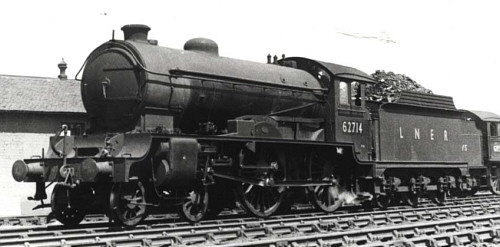
The first D49/1s were built with Wakefield 6-feed mechanical lubricators to lubricate the piston valves, and oilboxes in the cab for the axleboxes. This proved insufficient, and feeds from the mechanical lubricator were also fed to the outside cylinders. It was found to be impossible to route a satisfactory feed to the middle cylinder. The need for adequate lubrication was recognised when the D49/3s and D49/2s were built. The D49/3s were built with two 6-feed mechanical lubricators, and the D49/2s were built with two 8-feed lubricators.
Much of the initial design work on the D49/1s was performed by Chief Locomotive Draughtsman, R.J. Robson at Darlington, and included a mixture of Darlington and Doncaster practices. The three cylinders and steam chest were in one complete casting, following the Darlington practice introduced by Raven on his C7 Atlantics (NER Class Z). Another Darlington practice was the use of inside steam pipes instead of the Doncaster-style outside pipes. Doncaster practice came to the fore with the use of Gresley's conjugated valve gear on the middle cylinder. The coupled wheels were the Doncaster passenger standard of 6ft 8in diameter, while the bogie wheels followed the Darlington standard of 3ft 1.25in diameter.
A distinctive feature on the D49/1 piston valve engines, were the rectangular boxes fitted on the running boards just behind the smokebox. These boxes were sheet metal covers that housed the top of the expansion link in the outside valve motion which extended above the footplate line. These boxes were often confused for toolboxes.
Initially, the plan was for the D49/2s to use compound expansion following the Smith system. After continuing negotiations with Lentz Patents Ltd after the fitting of Lentz valve gear to J20 0-6-0 No. 8280, Gresley ordered six locomotives to be built with oscillating-cam operated Lentz poppet valves instead. These were ordered in 1926 and would become class D49/3. After joint design work by Lentz and Darlington, the six D49/3s were finally built in 1928. One reason for the apparent delay, were modifications to both the cam design and the rocking lever arm after Doncaster had proved the advantages of longer valve travel on the A1 Pacifics. The Lentz poppet valves were housed in individual valve boxes attached by bolts to the top of each cylinder. Each cylinder had four valves with an admission and exhaust valve at each end. All four valves were the same design and interchangeable.
The D49/3s used Walschaerts gear for their primary motion. Valve spindle guides were replaced by hanging arms and extension rods. These connected the combination levers with the cam rockers on the cam gear. The standard Gresley conjugated valve gear with a 2:1 arm was used for the middle cylinder, although the lever layout was changed to work in a vertical plane. It was argued that this would result in permanently tight valves, and hence less maintenance and better lubrication.
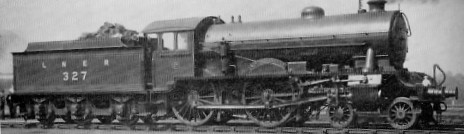
The D49/3s quickly gave problems with the mechanism that operated the oscillating camshaft. The valve rods in the middle cylinder's valve gear tended to bend under certain conditions, typically when the engine was in full gear. The problem was specific to the middle valve gear, and the resulting poor running could be felt on the footplate. In 1929, No. 329 was experimentally fitted with a conventional horizontal plane 2:1 lever. This quickly demonstrated a marked improvement, and the remaining five D49/3s were similarly modified.
Twelve months and 50,000 miles of express passenger work later, No. 329's middle valve gear failed again. The valves and cams were in good condition, but excess backward travel had allowed the rocking lever and valve rod to lock in a straight line. This resulted in the valve rod buckling, and the camshaft bending. The problem was circumvented by setting the D49/3's maximum cutoff to 62% and by restricting their use to less strenuous workings.
The D49/3s needed new cylinders in 1938, and the opportunity was taken to rebuild all of them as D49/1s with piston valves.
The D49/2 compounding proposal was formally dropped in 1927, and replaced with a design that used Lentz valves operated by rotary cam valve gear instead of the poppet valve gear on the D49/3s. By this point, Gresley had acquired quite a bit of experience with the oscillating cam operated Lentz valves after their application to J20 0-6-0 No. 8280, B12 4-6-0 No. 8516, and the D49/3s. The choice of rotary cam valve gear for the D49/2s, came from Gresley's belief that the Lentz poppet valves could not be used to their full advantage unless a simple rotary gear was developed. Certain aspects of the new design proved problematic. The main problem was the camshaft drive. This was solved using a skew gear which was tested on J20 No. 8280 in July 1927. Due to these delays designing the new valve gear, the first two D49/2s did not enter service until 1929.
Early reports from the Running Department were that the new D49/2 valve gear performed much better than on the existing six oscillating cam engines. The difference in performance was sufficient for all future D49s to be built with this new valve gear. It would also be used on P2 2-8-2 No. 2001 Cock o' the North.
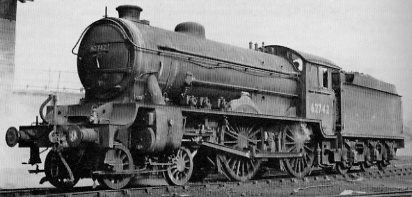
This new valve gear had five fixed cut-off positions. This proved insufficient, so No. 282 was built with a special hand-made camshaft that allowed a continuous variation in cut-off from 15% to 84%. Although no specific problems have been recorded, this does not appear to have been a success as it was removed during No. 282's first general repair in 1934. The cam was replaced with a seven step cam. The seven step cam was also fitted to No. 269 in 1934, and the last twenty five D49s were built with it.
Between 1935 and 1936, Darlington performed a number of trials with poppet valve gear. Most of these trials compared D49s which were identical except for their valve gear. The poppet valve locomotives were disappointing when compared against piston valve engines. The sudden changes in direction in the steam passages and the poppet valves, were also perceived to be as bad as on the piston valve locomotive. The piston valve engine also demonstrated better economy. It is not surprising then, that the poppet valve gear was quickly removed from P2 No. 2001 Cock o' the North. However, the two C7 4-4-2s and the D49/2s never had their poppet valve gear removed. The reason is unclear, but it was probably a combination of the large number of D49/2s in existence and the advent of World War 2. All of the D49/3s had been rebuilt with piston valve gear in 1938, so it is likely that the D49/2s would have been next.
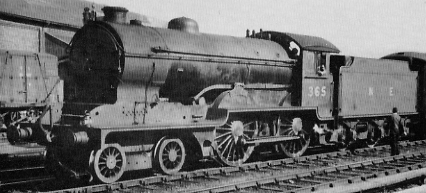
At the end of 1939, D49/2 No. 365 had a set of 'Reidinger' infinitely variable rotary cam poppet valve gear fitted. This time, the valves were controlled by steam pressure instead of springs. This proved troublesome. After receiving camshaft damage in January 1941, the valve gear was removed and stored. No. 365 would be rebuilt by Thompson as his prototype Class D (see below). In February 1949, British Railways re-assembled the infinitely variable rotary valve gear and fitted it to No. 62764 (ex- No. 361). Spring control was refitted. No. 62764 kept this valve gear until it was withdrawn in 1958.
Thompson became the LNER's Chief Mechanical Engineer in 1941, and initiated a major standardisation programme. As well as significantly reducing the number of classes in use by the LNER, this programme would include a number of major rebuilds. Many of these rebuilds were necessary due to the wartime shortages of raw materials and labour, as well as a national ban on the construction of new passenger locomotives. Thompson's standardisation plans included a 'Class D' locomotive for the intermediate express duties being performed by the D49s. In 1942, No. 365 was still in the works after a minor mishap in 1941, and it was chosen as the first rebuild to Class D. The rebuild kept the same boiler, but the three cylinder design was replaced by two inside cylinders following a pattern similar to the D11 4-4-0 'Improved Director' locomotives. Stephenson motion was used to operate piston valves. These piston valves were of the same diameter as those on the D49/1 but with a reduced travel. Some references refer to the rebuild as 'Class D49/4', but the official designation was always 'Class D'.
Initial trials were limited due to wartime conditions, but they included normal working from Neville Hill and two months working alongside D49/1s and D11s at Haymarket. The Class D rebuild was not a success, and No. 365 never reached the level of performance that it was previously capable of. In November 1947, Neville Hill quietly moved it to Starbeck and within a year, British Railways had cancelled the order for further Class D rebuilds. At Starbeck it was noted that with its regular drivers, No. 365 was capable of some fair performances. However there would be endless trouble if an unfamiliar driver took control. The main problem was the big end brasses which tended to run hot with high cut-offs. In 1952, No. 365 (now. No. 62768) was involved in a three engine collision at Dragon Junction near Starbeck. Damage was substantial, and No. 62768 was withdrawn. The other two locomotives were also D49s and both remained in service, with No. 62768's undamaged tender being swapped for No. 62758's damaged tender.
Regarding No. 365 Adam Roper knew one of No. 365's drivers, George Harris, and recalls "I knew one of The Morpeth's drivers (George Harris - known as 'Old George' because he was). His comment was that the engine's fault lay in the ash pan - unfamiliar crews would shovel ash over the big ends and contaminate the bearings, causing them to run hot. Other than that he was very proud of his engine because no one else had one like it. He wasn't driving on the day of the final accident, but regularly parked it outside his house so that he could tell if anyone was taking it out who shouldn't have been."
Initially the D49s were known for poor riding. After experiments with a variety of spring arrangements, this was eventually reduced to acceptable levels in 1934. One of the experiments involved a set of fifteen-plate laminated springs 0.5in thick that were the result of discussions between Stamer, Gresley, and Stanier. Although this design gave good initial results, frequent spring plate breakages started to occur. The final design was modified to have sixteen plates that were 5in wide.
During 1928 trials were performed with 'Kylala' blastpipes fitted to D49/1 No. 251 and D49/3 No. 322. Initial results with No. 251 were good, and No. 322 was fitted with a 'Kylala' blastpipe that incorporated some recommendations from Chapelon. The trial was cancelled in 1930 due to a lack of apparent improvement over a conventional blastpipe. This is rather strange when compared with both Chapelon's results on the Paris-Orleans Railway, and the significant improvements that were produced by later 'Kylchap' blastpipes on both the A3 and A4 Pacifics. Two different factors may have conspired to give this apparent lack of improvement. Firstly, the Kylala arrangement restricted access to some of the superheater elements. It is possible that this was over-emphasised by the Running Department. Secondly, no attempt was made to record the predicted reduction in back pressure, which was one of the main advantages in Gresley's opinion.
Gresley's three cylinder designs were known to be prone to heating problems on the middle big-end bearing. From early 1939, the D49s were fitted with a 'stink bomb' warning device to the inside of the crank axle. This consisted of a container of volatile pungent liquid. Any excessive heating would result in evaporation, and a very noticeable smell that could be detected on the footplate. A violet scent was initially used, but this was found to persist too long and was replaced with an aniseed scent.
The bulk of the D49s were allocated to the Scottish and North East (NE) areas. The Scottish Area received twenty four D49/1s and one D49/3. Most were allocated to St. Margaret's, Dundee, and Eastfield, with smaller numbers allocated to Perth and Haymarket. With the exception of transfers from Eastfield to Carlisle during the 1930s, Scottish allocations rarely changed. In 1939, the Scottish Area D49s were allocated to: St. Margaret's (5), Dundee (5), Carlisle (4), Eastfield (4), Haymarket (2), Perth (2), and Thornton (1). These D49s were used for main line passenger trains. Usually they hauled express services, but they were also seen on some semi-fast and stopping services as well. They would often be used alongside (or replacing) NBR C11 Atlantics and D11 'Directors'. The St. Margaret's and Carlisle D49s worked the Waverley Route, and acquired a good reputation on this difficult route.
By 1939, most of the A3 and V2 route restrictions had been lifted and these locomotives had displaced the D49s from their express passenger role. During World War Two, the Scottish D49s were often allocated to goods workings even though they were not particularly suited to this work. After the War, the D49s were used on stopping passenger services on the main line. The D49 had a relatively high axle loading which restricted them from many of the branch lines.
The D49s tended not to be particularly popular locomotives with the Scottish Area engine crews. This was mainly due to the poor ride, and the draughty cabs. Although it was vehemently denied by Gresley, Scottish crews widely thought that the D49s were built to replace the NBR C11 Atlantics.
The NE Area D49s were initially allocated to York and Neville Hill. Duties during this period included main line services to Newcastle, and cross-country services to Hull, Sheffield, Grantham, and Lincoln. They were also recorded hauling excursion services to King's Cross.
The advent of the D49/2 'Hunts' displaced the D49/3s to Botanic Gardens (Hull). At the end of 1933, the NE Area D49s were allocated to York (10), Neville Hill (9), Botanic Gardens (7), and Heaton (2). The Botanic Gardens D49s included two brand new D49/2s. These were the first brand new locomotives that the LNER allocated to this shed! During the 1930s, the D49s typically hauled seven to ten coach trains on moderate length (50-100 mile) journeys. The D49s were ideally suited to these duties, and they found plenty of such work in the NE Area.
The NE Area had a major re-allocation of D49s in 1939. By September 1939, the D49/2s were allocated to Neville Hill (15), York (10), Gateshead (8), Scarborough (5), and Botanic Gardens (4). All eleven NE Area D49/1s were allocated to Botanic Gardens. Allocations remained virtually constant until after Nationalisation (1948). Wartime conditions resulted in less services that suited the D49's abilities. Instead they were often called upon to haul heavy 350-400 ton trains, but they managed this with only a loss of a minute or two on their moderate length journeys.
British Railways (BR) quickly started to build large numbers of the Thompson B1 4-6-0s which tended to displace the D49s to less important duties. Allocations during this period included Pickering, Blaydon, and Selby. Some of the D49s in the Selby and Scarborough areas were even used to haul coal after 1955.
By the mid-1950s, the introduction of diesel multiple units and diesel locomotives reduced the available duties even further. Planned withdrawals in both regions started in September 1957. The last withdrawal was No. 62712 Morayshire in July 1961. This was privately purchased for preservation, and is currently restored to operating condition.
Technical Details
Tender details are for the LNER tenders. NER and GCR types were also fitted to the D49s.
| D49/1 | D49/2 | D49/3 | D | ||
| Cylinders: | 3x 17x26in. | 3x 17x26in. | 3x 17x26in. | 2x 18x26in. (inside) | |
| Motion: | Walschaerts / Gresley | Lentz rotary | Walschaerts Lentz cam | Stephenson | |
| Valves: | 8in piston | poppet | poppet | 8in piston | |
| Boiler: | Max. Diameter: | 5ft 6in | 5ft 6in | 5ft 6in | 5ft 6in |
| Boiler: | Pressure: | 180psi | 180psi | 180psi | 180psi |
| Diagram No.: | 97 | 97 | 97 | 97 | |
| Heating Surface: | Total: | 1669.58 sq.ft. | 1669.58 sq.ft. | 1669.58 sq.ft. | 1669.58 sq.ft. |
| Firebox: | 171.5 sq.ft. | 171.5 sq.ft. | 171.5 sq.ft. | 171.5 sq.ft. | |
| Superheater: | 271.8 sq.ft. (14x1.1in) | 271.8 sq.ft. (14x1.1in) | 271.8 sq.ft. (14x1.1in) | 271.8 sq.ft. (14x1.1in) | |
| Tubes: | 871.75 sq.ft. (177x 1.75in) | 871.75 sq.ft. (177x 1.75in) | 871.75 sq.ft. (177x 1.75in) | 871.75 sq.ft. (177x 1.75in) | |
| Flues: | 354.53 sq.ft. (24x 5.25in) | 354.53 sq.ft. (24x 5.25in) | 354.53 sq.ft. (24x 5.25in) | 354.53 sq.ft. (24x 5.25in) | |
| Grate Area: | 26 sq.ft. | 26 sq.ft. | 26 sq.ft. | 26 sq.ft. | |
| Wheels: | Leading: | 3ft 1.25in | 3ft 1.25in | 3ft 1.25in | 3ft 1.25in |
| Coupled: | 6ft 8in | 6ft 8in | 6ft 8in | 6ft 8in | |
| Tender: | 3ft 9in | 3ft 9in | 3ft 9in | 3ft 9in | |
| Tractive Effort: | (@ 85% boiler pressure) | 21,556 | 21,556 | 21,556 | 19,890 |
| Wheelbase: | Total: | 48ft 5.25in | 48ft 5.25in | 48ft 5.25in | 48ft 5.25in |
| Engine: | 24ft 11in | 24ft 11in | 24ft 11in | 24ft 11in | |
| Tender: | 13ft 6in | 13ft 6in | 13ft 6in | 13ft 6in | |
| Weight (full): | Total: | 118 tons 4cwt | 117 tons 3cwt | 118 tons 7cwt | 114 tons 13cwt |
| Engine: | 65 tons 11cwt | 64 tons 10cwt | 65 tons 14cwt | 62 tons 0cwt | |
| Tender: | 52 tons 13cwt | 52 tons 13cwt | 52 tons 13cwt | 52 tons 13cwt | |
| Adhesive Weight: | 42 tons | 41 tons 10cwt | 41 tons 18cwt | 41 tons 6cwt | |
| Max. Axle Load: | 21 tons 5cwt | 21 tons | 21 tons 2cwt | 20 tons 19cwt |
Preservation
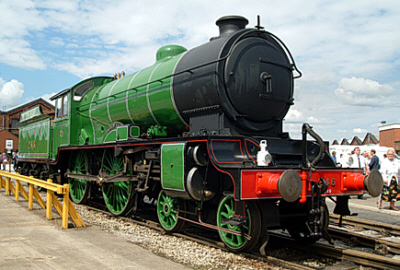
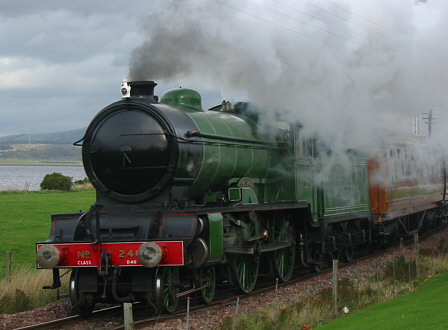
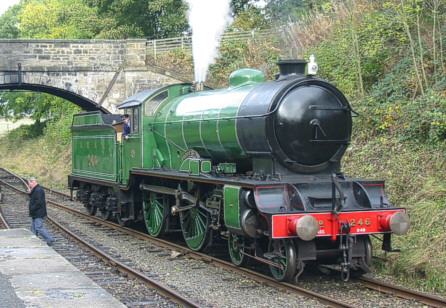
No. 246 Morayshire was purchased by Ian Fraser and donated to the Royal Scottish Museum. It was restored to running condition and appeared at the Stockton & Darlington 150 celebrations, but spent much of the 1980s and 1990s in static condition. Morayshire was loaned to the Scottish Railway Preservation Society who returned her to running condition in 2005. She is currently located on the Bo'ness & Kinneil Railway.
Models
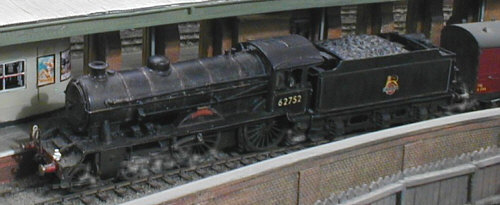
In the past, Hornby have sold a ready-to-run version of the D49 in OO gauge. This had a tender drive and was produced in both Hunt and Shire versions. It is due to be re-released in the 'Railroad' range with a locomotive drive. The adjacent picture is of a Hornby Shire that has been modified into a D49/2 Hunt by Colombo. Colombo uses this D49/2 to haul the empty Scarborough to Gascoigne Wood coal trains on his York layout.
The D49 is a popular kit in 4mm scale. DJH sell a kit of the D49 Hunt/Shire class in OO gauge (4mm scale). 4mm kits are also available from Comet Models who sell a number of D49 component packs, McGowan who sell whitemetal kits of both versions, and PDK who sell etched kits of both the Hunt and Shire versions.
ACE Products produce a kit for O gauge (7mm scale).
Locomotives
The piston valve D49/1 locomotives were named after counties, and all but three ended in "-shire". The counties were generally those with LNER lines, although there some odd choices especially in the final D49/1 batch intended for Scotland. For example No. 2755 Berkshire represented a county that had no LNER lines whatsoever. At the opposite end of the spectrum, no D49 was named after County Durham - at the heart of the LNER's NE Area and where all of the D49s were built!
The Lentz D49/2 and D49/3 locomotives were named after fox hunts. The first two D49/2s built in 1929 were originally named No. 336 Buckinghamshire and No. 352 Leicestershire. To bring them in line with the hunt theme, in 1932 these were renamed to The Quorn and The Meynell, respectively. The full list of hunts are listed on a separate page.
Note that the spelling of No. 281 is correct in the following table. Throughout its life, No. 281 carried the mis-spelt name of Dumbartonshire. The correct name for the county is Dunbartonshire although the county town is named Dumbarton.
Nos. 318-329 were rebuilt from D49/3 to D49/1 in 1938. No. 365 was rebuilt as Class D in 1942.
| LNER No. | 1946 No. | BR No. | Class Part (D49/) | Build Date | Disposal Date | Name |
| 234 | 2700 | 62700 | 1 | 10/27 | 10/58 | Yorkshire |
| 251 | 2701 | 62701 | 1 | 11/27 | 9/59 | Derbyshire |
| 253 | 2702 | 62702 | 1 | 11/27 | 11/58 | Oxfordshire |
| 256 | 2703 | 62703 | 1 | 12/27 | 6/58 | Hertfordshire |
| 264 | 2704 | 62704 | 1 | 12/27 | 8/58 | Stirlingshire |
| 265 | 2705 | 62705 | 1 | 12/27 | 11/59 | Lanarkshire |
| 266 | 2706 | 62706 | 1 | 12/27 | 2/58 | Forfarshire |
| 236 | 2707 | 62707 | 1 | 1/28 | 10/59 | Lancashire |
| 270 | 2708 | 62708 | 1 | 1/28 | 5/59 | Argyllshire |
| 277 | 2709 | 62709 | 1 | 1/28 | 1/60 | Berwickshire |
| 245 | 2710 | 62710 | 1 | 2/28 | 10/60 | Lincolnshire |
| 281 | 2711 | 62711 | 1 | 2/28 | 5/61 | Dumbartonshire |
| 246 | 2712 | 62712 | 1 | 2/28 | 7/61 | Morayshire |
| 249 | 2713 | 62713 | 1 | 2/28 | 9/57 | Aberdeenshire |
| 250 | 2714 | 62714 | 1 | 3/28 | 8/59 | Perthshire |
| 306 | 2715 | 62715 | 1 | 3/28 | 6/59 | Roxburghshire |
| 307 | 2716 | 62716 | 1 | 3/28 | 4/61 | Kincardineshire |
| 309 | 2717 | 62717 | 1 | 3/28 | 1/61 | Banffshire |
| 310 | 2718 | 62718 | 1 | 5/28 | 4/61 | Kinross-shire |
| 311 | 2719 | 62719 | 1 | 5/28 | 1/60 | Peebles-shire |
| 318 | 2720 | 62720 | 3,1 | 5/28 | 10/59 | Cambridgeshire |
| 320 | 2721 | 62721 | 3,1 | 5/28 | 8/58 | Warwickshire |
| 322 | 2722 | 62722 | 3,1 | 7/28 | 10/59 | Huntingdonshire |
| 327 | 2723 | 62723 | 3,1 | 7/28 | 1/61 | Nottinghamshire |
| 335 | 2724 | 62724 | 3,1 | 8/28 | 12/57 | Bedfordshire |
| 329 | 2725 | 62725 | 3,1 | 8/28 | 11/58 | Inverness-shire |
| 352 | 2726 | 62726 | 2 | 3/29 | 12/57 | The Meynell |
| 336 | 2727 | 62727 | 2 | 6/29 | 1/61 | The Quorn |
| 2753 | 2728 | 62728 | 1 | 2/29 | 10/59 | Cheshire |
| 2754 | 2729 | 62729 | 1 | 4/29 | 5/61 | Rutlandshire |
| 2755 | 2730 | 62730 | 1 | 3/29 | 12/58 | Berkshire |
| 2756 | 2731 | 62731 | 1 | 3/29 | 4/59 | Selkirkshire |
| 2757 | 2732 | 62732 | 1 | 3/29 | 11/58 | Dumfries-shire |
| 2758 | 2733 | 62733 | 1 | 3/29 | 4/61 | Northumberland |
| 2759 | 2734 | 62734 | 1 | 5/29 | 3/61 | Cumberland |
| 2760 | 2735 | 62735 | 1 | 6/29 | 8/58 | Westmorland |
| 201 | 2736 | 62736 | 2 | 4/32 | 6/58 | The Bramham Moor |
| 211 | 2737 | 62737 | 2 | 5/32 | 1/58 | The York and Ainsty |
| 220 | 2738 | 62738 | 2 | 5/32 | 9/59 | The Zetland |
| 232 | 2739 | 62739 | 2 | 5/32 | 10/60 | The Badsworth |
| 235 | 2740 | 62740 | 2 | 6/32 | 8/60 | The Bedale |
| 247 | 2741 | 62741 | 2 | 7/32 | 10/58 | The Blankney |
| 255 | 2742 | 62742 | 2 | 8/32 | 11/58 | The Braes of Derwent |
| 269 | 2743 | 62743 | 2 | 8/32 | 5/60 | The Cleveland |
| 273 | 2744 | 62744 | 2 | 10/32 | 12/60 | The Holderness |
| 282 | 2745 | 62745 | 2 | 10/32 | 3/59 | The Hurworth |
| 283 | 2746 | 62746 | 2 | 8/33 | 5/58 | The Middleton |
| 288 | 2747 | 62747 | 2 | 8/33 | 3/61 | The Percy |
| 292 | 2748 | 62748 | 2 | 8/33 | 12/57 | The Southwold |
| 297 | 2749 | 62749 | 2 | 8/33 | 7/58 | The Cottesmore |
| 298 | 2750 | 62750 | 2 | 9/33 | 11/58 | The Pytchley |
| 205 | 2751 | 62751 | 2 | 7/34 | 3/59 | The Albrighton |
| 214 | 2752 | 62752 | 2 | 7/34 | 7/58 | The Atherstone |
| 217 | 2753 | 62753 | 2 | 7/34 | 9/59 | The Belvoir |
| 222 | 2754 | 62754 | 2 | 7/34 | 11/58 | The Berkeley |
| 226 | 2755 | 62755 | 2 | 7/34 | 11/58 | The Bilsdale |
| 230 | 2756 | 62756 | 2 | 8/34 | 4/58 | The Brocklesby |
| 238 | 2757 | 62757 | 2 | 8/34 | 12/57 | The Burton |
| 258 | 2758 | 62758 | 2 | 8/34 | 12/57 | The Cattistock |
| 274 | 2759 | 62759 | 2 | 8/34 | 1/61 | The Craven |
| 279 | 2760 | 62760 | 2 | 9/34 | 10/59 | The Cotswold |
| 353 | 2761 | 62761 | 2 | 9/34 | 12/57 | The Derwent |
| 357 | 2762 | 62762 | 2 | 9/34 | 10/60 | The Fernie |
| 359 | 2763 | 62763 | 2 | 9/34 | 1/61 | The Fitzwilliam |
| 361 | 2764 | 62764 | 2 | 10/34 | 11/58 | The Garth |
| 362 | 2765 | 62765 | 2 | 10/34 | 1/61 | The Goathland |
| 363 | 2766 | 62766 | 2 | 11/34 | 9/58 | The Grafton |
| 364 | 2767 | 62767 | 2 | 11/34 | 10/58 | The Grove |
| 365 | 2768 | 62768 | 2,D | 12/34 | 11/52 | The Morpeth |
| 366 | 2769 | 62769 | 2 | 12/34 | 9/58 | The Oakley |
| 368 | 2770 | 62770 | 2 | 12/34 | 9/59 | The Puckeridge |
| 370 | 2771 | 62771 | 2 | 1/35 | 10/58 | The Rufford |
| 374 | 2772 | 62772 | 2 | 1/35 | 9/58 | The Sinnington |
| 375 | 2773 | 62773 | 2 | 1/35 | 8/58 | The South Durham |
| 376 | 2774 | 62774 | 2 | 2/35 | 11/58 | The Staintondale |
| 377 | 2775 | 62775 | 2 | 2/35 | 12/58 | The Tynedale |
Acknowledgements
Thanks to Colombo (from the forums) who provided the photograph of his 4mm scale D49/2. Colombo modified a Hornby D49/1 Shire to produce the D49/2 Hunt.
Thank you to Geoff Byman FRPS for the photograph of D49 No. 246 Morayshire at the Doncaster 150 celebrations.
Thank you to Mark Ashmole of the SRPSS for Roger Haynes' photographs of D49 No. 246 Morayshire in steam.
Acknowledgements
Thank you Malcolm Peirson for the photograph of D49/1 BR No. 62714 Perthshire.